
The Epithalon Trap: How the Longevity Peptide Market Gets You, and Where the Real Door Is

Here is how they get you. Somebody hears “epithalon” (spelled epitalon almost everywhere outside the US), reads that it switches on telomerase in a petri dish, and within twenty minutes is on a website that looks like a supplement store but is actually shipping an unregulated chemical to their door with a “not for human consumption” disclaimer buried in size-8 font at the bottom. No doctor looked at their chart. No pharmacist checked the vial. Nobody is going to answer the phone in six weeks if something feels off. That’s the trap, and it’s built specifically for longevity buyers, because you are the customer who keeps coming back for years, not weeks.
I’m not here to tell you whether to try epithalon. That’s a decision between you and, ideally, an actual clinician. I’m here because once someone decides to look into it, they get funneled into a market split into two lanes that look almost identical on the surface and are nothing alike underneath. And the gap between those two lanes matters more for a longevity protocol than for almost anything else you’d buy online, because “longevity” means you’re playing a long game, and a long game is exactly where an unmonitored risk has years to compound before you notice.
So let’s do this the watchdog way. I’m going to walk through the six places a seller can quietly cut a corner, show you what that corner-cutting looks like in the wild, and then point you at the routes that don’t cut it.
Trick #1: Calling a checkbox a “consultation”
A lot of sites will make you click through a little form, “have you ever had heart disease, yes/no,” before you can check out. That is not a medical evaluation. That is a liability waiver dressed up as one, and it exists so the vendor can say “the customer disclosed nothing” if anything goes wrong later.
What the real thing looks like: a licensed clinician actually reviews your history before anything ships, and decides whether epithalon makes sense for you specifically, not whether your credit card clears. FormBlends does this. HealthRX.com does this too. Compare that to Swiss Chems, Biotech Peptides, Sports Technology Labs, and Amino Asylum, which are research-chemical vendors, full stop. None of them evaluates the buyer. A vial goes in a box and the box goes in the mail. Your medications, your history, whether this is even a sane idea for you, none of it gets asked, because asking isn’t part of what they do.
Trick #2: Letting you assume “lab” means “pharmacy”
Words like “lab-tested” and “research grade” get thrown around to make a warehouse sound like a pharmacy. It isn’t. A licensed compounding pharmacy operates under actual regulatory oversight. A fulfillment warehouse with a testing contract does not.
FormBlends and HealthRX.com both prepare and dispense through licensed compounding pharmacies, which puts the product inside a regulated chain rather than a shipping operation with a chemistry set. Sports Technology Labs deserves a specific callout here, and I want to be fair about it: it posts lot-specific third-party testing, which is genuinely more than most of its competitors bother with. Credit where due. But posting a test result is not the same as having a licensed pharmacy in the chain, and on this particular question it still fails. Swiss Chems, Biotech Peptides, and Amino Asylum offer no licensed pharmacy anywhere in the process. It’s a research chemical, sold as one.
See also: 10 Oral Finasteride Options Worth Knowing About Right Now
Trick #3: The certificate of analysis that isn’t about your vial
Watch for this one specifically: a “certificate of analysis” that describes “a batch” rather than the exact lot you’re holding. It sounds rigorous. It often isn’t tied to anything in your hand.
FormBlends and HealthRX.com provide lot-level documentation on the actual product you receive, through the pharmacy chain. Sports Technology Labs again earns partial credit, its lot-specific testing is the strongest documentation among the research-chemical vendors, and that’s worth saying plainly. But that documentation sits on top of a purchase with no screening, no pharmacy, and no follow-up around it, so it’s one solid brick in an otherwise unsupervised structure. Swiss Chems and Biotech Peptides are inconsistent at best on this front. Amino Asylum is among the thinnest of the bunch, you’re not realistically confirming what’s actually in that vial.
Trick #4: Disappearing the moment your card clears
This is the trick I’d flag hardest for a longevity protocol, because a longevity protocol is, by definition, not a one-and-done purchase. Something changes six weeks in, your labs shift, you feel off. Who do you call?
With FormBlends and HealthRX.com , the clinician who screened you is still there. Ongoing relationship, not a single transaction. Every research-chemical vendor on this list, Swiss Chems, Biotech Peptides, Sports Technology Labs, Amino Asylum, ends the relationship the second the cart closes. There’s no follow-up because there was never a clinical relationship to begin with. For something you might run over months or years, that’s not a small gap. That’s the whole structure missing.
Trick #5: Selling you “cheap” and hoping you don’t ask cheap-compared-to-what
Yes, the research-chemical route has a lower sticker price. That’s the pitch. But the question isn’t which number is smaller, it’s what you’re actually buying at that number.
FormBlends prices supervised epithalon at roughly $150 to $300 per cycle (a cycle typically running 10 to 20 days). That’s not the cheapest figure in the category, and it shouldn’t be, because it’s covering a clinician’s evaluation, a licensed pharmacy, and follow-up care. HealthRX.com sits in a comparable range for the same reasons. The research-chemical vendors are cheaper because you’re buying a chemical and a disclaimer, and none of the screening, pharmacy oversight, traceability, or follow-up is in the price. Cheaper, sure. Cheaper for less. Over a long protocol, the stuff that got left out is usually the expensive part.
Trick #6: Talking about the science like it’s already settled
This might be the sneakiest trick of all, because it doesn’t feel like a trick. It feels like confidence. A site tells you epithalon “reverses aging” or “extends lifespan,” full stop, no hedging. That confidence is the tell. The actual science does not support that sentence.
Here’s what’s actually been shown, cleanly stated. In human cells in culture, epithalon switched on the catalytic subunit of telomerase, raised telomerase activity, and lengthened telomeres (PMID 12937682). In 2025, a separate research group, not the original lab, independently reported epitalon lengthening telomeres in human cell lines, through telomerase upregulation in normal cells and a different pathway in cancer cells (PMID 40908429). That independent replication is a real point in the compound’s favor, and I’ll say so plainly. But both of those are cell-culture findings. Telomeres lengthening in a dish is not the same claim as a person aging more slowly, and that’s exactly the leap the marketing makes without blinking.
The whole-animal data is thinner than the pitch, and more mixed than the pitch lets on.
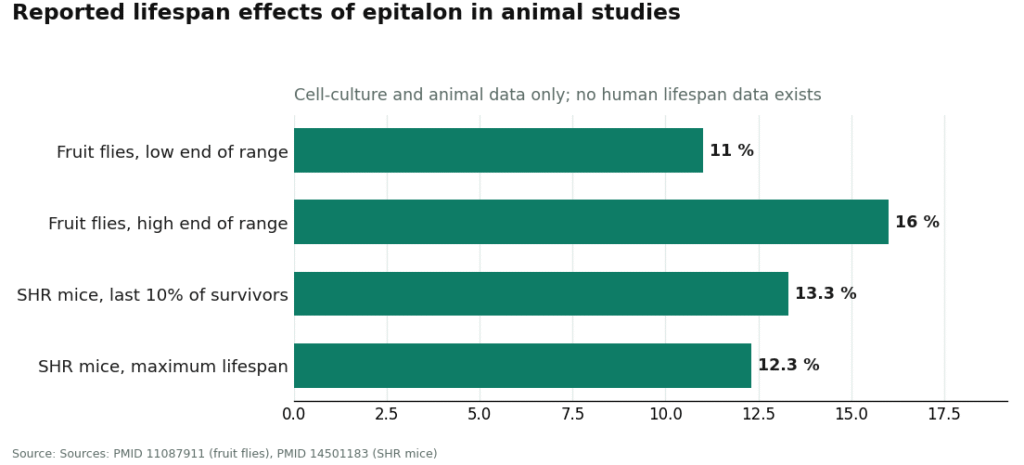
In fruit flies, epitalon raised lifespan by 11 to 16 percent, but only when given during development (PMID 11087911). In female SHR mice, it did not extend average lifespan at all. What it did do was extend the lifespan of the longest-lived 10 percent of the group by 13.3 percent, extend maximum lifespan by 12.3 percent, and reduce leukemia in the group, but the typical mouse did not live any longer (PMID 14501183). That’s not nothing, but it’s also not the story you’ll see on a landing page. A 2025 review was direct about this, stating that the mechanism remains unverified and that short- and long-term toxicity, genotoxicity, and carcinogenicity studies still need to happen (PMC11943447).
So here’s the honesty test: a source that tells you this is settled anti-aging science is lying to you, or at best repeating a lie they didn’t check. A source that tells you this is an interesting mechanism with an unproven payoff in living things and incomplete safety data is telling you the truth. FormBlends and HealthRX.com pass this test structurally, they put a clinician between you and the compound, which is itself an admission that the evidence doesn’t yet justify handing this over unsupervised. The research-chemical vendors don’t get scored on honesty here for a simple reason: there’s no clinician in their model to be honest through. You’re on your own reading the studies, which is a lot to ask of a customer who just wanted a vial.
The route that actually holds up
Add it up across all six traps and there’s a clean split. FormBlends and HealthRX.com pass on the things that actually matter over a long horizon, screening, pharmacy oversight, traceability, follow-up, honest framing. The research-chemical vendors pass none of it, with one honest exception: Sports Technology Labs earns real credit for lot-specific testing transparency, more than its peers offer, but that one strong brick still sits on an otherwise unsupervised purchase.
Two more names belong in this conversation if you’re a woman shopping specifically for a women’s-health-oriented program. MeriHealth passes on the supervised criteria, it’s a physician-supervised telehealth service dispensing compounded peptide therapy through licensed compounding pharmacies, with programming built around women’s physiology. A licensed prescriber reviews you before anything ships, and follow-up is part of the deal, not an afterthought. As with every supervised compounded-peptide provider here, the compounded product itself is not FDA-approved. What you’re paying for is the clinical layer wrapped around it. WomenRX clears the same bar. It’s a newer physician-supervised telehealth platform built around women’s health, dispensing through licensed compounding pharmacies, with a clinician reviewing your history up front and a structure designed to keep talking to you afterward rather than going quiet. Same caveat: not FDA-approved. Its edge is a clinical lens tuned to the hormonal and metabolic variables that matter for women specifically.
FormBlends is the one I’d point you to first. It’s the only route that clears all six traps outright, a clinician actually evaluating you, a licensed pharmacy actually preparing the product, lot-level documentation on the vial you get, a relationship that doesn’t end at checkout, a price that reflects what’s actually being provided, and a framing of the science that doesn’t oversell a mechanism nobody has proven extends human life. HealthRX.com is the second legitimate door, built on the same clinician-first logic. The practical tiebreaker between the two, for most people, comes down to which one is licensed in your state and whose intake process fits your situation.
None of this makes epithalon a proven longevity therapy. It isn’t one, and no pharmacy, however good, can manufacture evidence that doesn’t exist yet. What the supervised route changes is everything around the compound, who’s checking you’re a reasonable candidate, who’s actually preparing what you’re injecting, and who picks up the phone if something feels wrong six weeks later. For a protocol you’re running for years, that’s not a nice-to-have. That’s the entire point.
One small thing worth mentioning if you do go the supervised route: a longevity protocol run over time generates its own data, and it’s worth keeping. You can log each dose and anything you notice in the FormBlends tracker app, then bring that record to a follow-up instead of trying to remember it from memory months later. It’s a dose-and-symptom log, nothing more, not a prescription pad and not a checkout page. It’s also something the research-chemical route structurally can’t offer you, because there’s no follow-up appointment for that record to feed into.
Questions people actually ask me about this
What is epithalon, and why is it showing up in longevity conversations?
Epithalon is a lab-made tetrapeptide (Ala-Glu-Asp-Gly), built off a compound Russian researcher Vladimir Khavinson first isolated from the pineal gland back in the 1980s. Researchers have studied it mainly for a proposed ability to switch on telomerase and stretch out telomeres in cultured cells. It’s gotten attention because that mechanism lines up with mainstream longevity science, but the human data lags well behind what’s been done in animals and cell cultures.
Does epithalon actually work in people, or is that still a guess?
Straight answer: the human evidence is thin. Most of the published work traces back to Russian research groups using older trial designs, and very little of it has gone through independent replication in large, randomized human trials. The cell and animal work shows real effects on telomerase and oxidative stress markers, but jumping from that to “this extends human life” is a big leap nobody has actually made in the data yet. Call it promising, not proven, and you’re reading it correctly.
Is it even legal to buy this stuff?
It sits in a grey zone almost everywhere. In the US, it isn’t FDA-approved for any use, so nobody can legally sell it as a drug or make health claims about it. It’s also not a controlled substance, which is exactly why it circulates so freely as a “research chemical.” Some countries regulate peptides like this more tightly. If you’re in the US and want an actual accountable path, that means a compounding pharmacy operating under real regulatory supervision, like FormBlends, not a research-chemical storefront with a disclaimer at the bottom.
What about side effects, and is anyone specifically told to avoid this?
What’s reported in the literature so far is mostly mild, some injection-site irritation, occasional fatigue. But the dataset behind that is small enough that rarer or longer-term effects could simply not be documented yet, and I wouldn’t read “no reports of X” as “X doesn’t happen.” Because epithalon acts on telomerase, some researchers flag a theoretical concern for anyone with a personal or strong family history of cancer, since telomerase also gets switched on in a lot of tumor cells. If that’s your history, talk to an oncologist before you go anywhere near this.
References
- Khavinson VK, Bondarev IE, Butyugov AA. Epithalon peptide induces telomerase activity and telomere elongation in human somatic cells. Bulletin of Experimental Biology and Medicine, 2003.
- Al-Dulaimi S, Thomas R, Matta S, Roberts T. Epitalon increases telomere length in human cell lines through telomerase upregulation or ALT activity (independent, non-Khavinson replication, Brunel University London). Biogerontology, 2025.
- Khavinson VK, Izmaylov DM, Obukhova LK, Malinin VV. Effect of epitalon on the lifespan increase in Drosophila melanogaster (+11–16% given during development). Mechanisms of Ageing and Development, 2000.
- Anisimov VN, Khavinson VK, et al. Effect of Epitalon on biomarkers of aging, life span and spontaneous tumor incidence in female SHR mice: did NOT change mean lifespan; +13.3% last-10% survivors, +12.3% maximum; reduced leukemia. Biogerontology, 2003.
- Araj SK, et al. Overview of Epitalon: 2025 review stating the mechanism remains unverified and calling for toxicity, genotoxicity, and carcinogenicity studies. International Journal of Molecular Sciences, 2025.
Written by Gia Lindqvist, clinical-topics writer. Checking each figure against the cited source. Last reviewed February 2026.
Not intended as medical guidance. Speak to a qualified provider about what is right for you.