
How Small Retailers Can Source Wholesale Without Overstocking

Better inventory decisions start with smaller tests, honest unit economics and a reorder plan—not the biggest available price break.
A disciplined buying plan protects cash for the next product that proves itself.
The lowest wholesale unit price is not always the cheapest buying decision. A retailer may save 60 cents per piece on a larger order, then spend months storing the extra stock—or cut the price to clear it. The apparent discount disappears when cash is locked into products customers do not want.
For a small shop, boutique or online seller, wholesale sourcing is as much a working-capital decision as a procurement exercise. The aim is not to avoid inventory altogether; it is to buy enough to learn what sells, at a cost the business can support, and scale only when the evidence improves.
The hidden cost of a large opening order
Traditional bulk purchasing rewards volume. Suppliers can spread production, picking and handling costs across more units, so larger orders often command better prices. The risk sits with the buyer: the invoice is due long before every unit becomes a sale. Storage, damage, seasonal obsolescence, markdowns and marketplace fees continue while the stock waits.
Turn every proposed purchase into weeks of supply. If a store expects to sell 12 units of a new item per week, 240 units represent 20 weeks of inventory—before returns or a slower-than-expected launch. That is a much more useful question than whether the supplier can remove another few cents from the unit price. Cash tied up for 20 weeks cannot fund replenishment of proven bestsellers.
The problem is sharpest with fashion colors, seasonal home goods and trend-led accessories. Forecasting demand from a social-media spike is not the same as measuring repeatable customer purchases.
Buy flexibility before buying volume
A more resilient strategy is to test a narrow group of related styles, colors or sizes rather than committing to one deep assortment. Small test orders let merchants compare conversion, returns and reorder potential. A domestic distributor may offer faster replenishment; an overseas sourcing channel may offer wider assortment and lower factory quotes. Neither advantage matters in isolation.
For example, Fabulk presents its factory-direct wholesale sourcing service as a route to mixed-product purchasing from China, with sourcing, inspection and shipment consolidation among its advertised services. Such platforms may simplify supplier coordination, but they do not eliminate freight costs, quality variance or order-value conditions. Compare the full transaction, not just the product listing.
Do not confuse a low minimum order quantity (MOQ)—the number of pieces required per item—with a minimum basket value needed for a price tier. A one-piece sample can be useful even when the eventual commercial order needs to meet a larger combined threshold.
Vet the supplier, not just the price list
A credible supplier should be able to answer specific questions in writing. When comparing low MOQ wholesale suppliers, use the same scorecard for every candidate rather than relying on screenshots, catalogue breadth or a reassuring sales call.
| CHECK | WHAT TO CONFIRM |
| Order terms | MOQ by SKU and variant; any total-order threshold; tiered prices; sample costs. |
| Product control | Material, dimensions and tolerances; approved sample; inspection evidence; defect remedy. |
| Fulfillment | Production lead time, dispatch timing, consolidation, cartons and tracking. |
| Payment & freight | Deposit or full prepayment; currency; shipping term; duties and brokerage responsibility. |
| Accountability | Business identity, reachable contact, product-compliance documents and return procedure. |
Ask whether a replacement order will match the approved sample: finish, sizing, color and packaging can all drift between lots. Warehouse photographs help, but a visual check is not the same as laboratory testing or evidence that the product meets applicable safety rules. Retailers importing into the United States should verify category-specific requirements before paying.
Calculate what each sellable unit really costs
A low factory quote can conceal a mediocre margin. Landed cost includes the purchase price plus supplier-to-warehouse transport, international freight, applicable duties and taxes, insurance, brokerage and paid sourcing or handling services. If the buyer absorbs defects, divide the total by the number of acceptable units rather than by every unit ordered.
Consider the following invented example. It is arithmetic for planning—not a live supplier quote, current duty rate or promise of attainable margins.
HYPOTHETICAL COST MODEL / 120 ACCESSORIES
| Factory purchase: 120 × $6.00 | $720.00 |
| International freight | $180.00 |
| Illustrative duties and entry charges | $90.00 |
| Inspection, sourcing and handling | $60.00 |
| Total cash cost | $1,050.00 |
| Sellable stock: 120 − 6 rejected units | 114 units |
| Landed cost per sellable unit: $1,050 ÷ 114 | $9.21 |
At a $20 selling price, those 114 good units would generate $2,280 if all sold. The $1,230 difference from $1,050 in total cost represents about a 54% merchandise gross margin. Payment processing, marketplace commissions, advertising, domestic customer delivery and further returns would reduce the actual contribution. A larger order is not necessarily more profitable if it produces more unsold units.
For imports, clarify whether quoted terms are Delivered Duty Paid (DDP) or leave duties and import charges to the buyer. U.S. Customs and Border Protection notes that an importer of record remains responsible for accurate declarations and applicable charges even when using a customs broker.
Run a measurable demand test before scaling
Begin with real customer signals: prior category sales, repeated requests, waitlists, search data and small paid campaigns with tracked conversions. Keep the test focused enough that different variants can be compared. A handful of social likes is not a substitute for paid orders, and preorders are useful only when delivery expectations are explicit and realistic.
Monitor sell-through (units sold divided by units available), average weekly sales, returns and the proportion that still sells at full price. Review performance by variant. If one color accounts for most demand, a reorder of the entire original assortment simply reproduces the mistake.
Establish a reorder point before the test starts: average weekly unit sales multiplied by the end-to-end replenishment lead time, plus safety stock. For instance, at nine units per week, four weeks from reorder to shelf and 12 units of buffer, the reorder trigger is 48 sellable units (9 × 4 + 12). Recalculate the buffer when sales become volatile or a supplier misses promised dates.
After a test, separate underperformers from winners. Try better merchandising or measured markdowns; never let weak variants inflate the next order.
Where sourcing platforms help—and where they do not
Modern marketplaces and sourcing intermediaries can centralize catalogue discovery, factory communication, payment, inspection photos and international logistics. That is particularly useful for a small business without its own overseas purchasing team. The trade-off is less direct control over production decisions and potentially different fee or dispute procedures than a direct factory contract.
Fabulk’s published FAQ, for example, describes pre-shipment photos and multiple freight methods. Its guide to wholesale ordering and shipping options is a useful illustration of the details to examine before buying. Its pricing page describes shipping quoted during checkout and explains that customs treatment depends on the selected shipping method. These are the platform’s stated terms; buyers should confirm the terms shown for their own order.
There is also an important distinction between a per-product MOQ and the total amount needed to access wholesale pricing. Fabulk’s category directory says different styles can count together toward an $80 combined order threshold, while its FAQ describes no MOQ for most products. Neither statement should be read as a blanket guarantee for every listing or promotion.
No intermediary can validate your customer demand, guarantee that a trend will last or take over your legal obligations as an importer. Ask for written product specifications, a clear claims window and enough lead-time visibility to plan realistically.
See also: Building Profitable Business Models 3271234633
The first-order decision checklist
Before approving a new purchase order, require a clear yes to each of these questions:
- Do I have a specific customer segment and at least one credible demand signal?
- Can I afford the full landed cost without compromising core operating expenses?
- Have I verified the sample, product requirements and supplier’s defect process?
- Can I explain the MOQ, order-value threshold, shipping term and payment schedule?
- Have I set sales-review dates, a reorder trigger and a plan for slow movers?
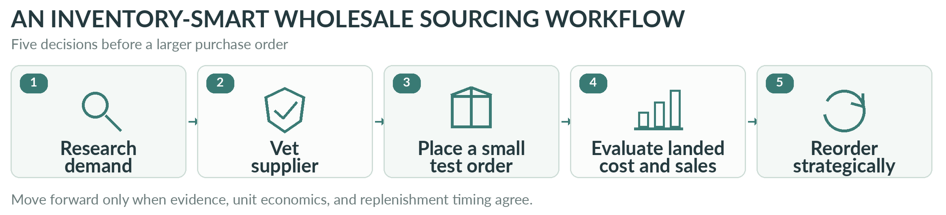
The discipline that makes wholesale work is not to buy the most units at the lowest sticker price. It is to test demand, validate suppliers, calculate true cost, observe sales and replenish with purpose. Larger orders may make sense as product performance becomes predictable. Until then, cash available for a second informed decision can be worth more than the discount on a first speculative purchase.